
March
Scaffold and Ladder Safety


March focuses on one of the leading causes of serious injuries in construction — falls from elevation. This month’s curriculum challenges teams to think differently about how we access work at heights.
Rather than defaulting to ladders out of convenience, we reinforce a prevention-first mindset through scaffold safety, hazard recognition, and our Ladders Last policy.
From proper foundations and daily inspections to selecting the right access method for the task, this month equips crews with the knowledge and accountability needed to reduce fall risk and protect lives.
This isn’t just about compliance.
It’s about decision-making, ownership, and choosing the safest method every time.

WEEK 1 - Scaffold Safety: Set It on a Solid Base
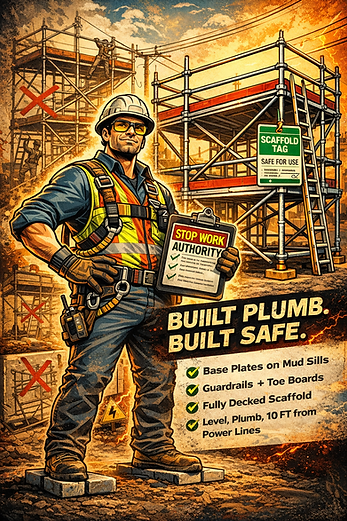
This week emphasizes proper scaffold setup, fall protection requirements, and the critical role of the designated Competent Person. Workers are reminded that scaffolds must be built square, level, and plumb with base plates and mud sills properly installed. Guardrails, toe boards, full decking, and proper access are not optional — they are essential.
Multiple Guess 1. What is required at the base of every scaffold leg? A) Cribbing B) Concrete blocks C) Mud sills and base plates D) Guardrails 2. If a scaffold working deck is 12 feet high, what is required? A) Three points of contact B) Only guardrails C) Some form of fall protection D) Nothing if experienced 3. If a scaffold exceeds a 4:1 height-to-base ratio, what risk increases? A) Rust B) Tip-over C) Electrical shock D) Slippery deck 4. When must scaffolds be kept at least 10 feet from power lines? A) Only during storms B) Only when metal planks are used C) Always D) Only if over 20 feet tall 5. Who has authority to stop work on unsafe scaffolding? A) Any worker B) The competent person C) The newest employee D) The crane operator Limited Response 1. Scaffold decks must be fully __________ with no significant gaps. 2. Guardrails are intended for protection, and not for gaining additional __________. 3. The ground beneath a scaffold must be firm and able to support it without __________. Discussion If you walk up to a scaffold and something just “doesn’t look right,” what specific things would make you pause before climbing it? What pressures could cause someone to ignore a setup issue on a scaffold?
WEEK 2 - Scaffold Safety: Inspect Before You Step

This week focuses on identifying both current hazards and those that may develop as work progresses. Workers are reminded to keep platforms clear of excess materials, avoid working on slippery surfaces, and never use makeshift platforms such as pallets or concrete blocks.
Special emphasis is placed on structural integrity. Rust, bent members, and cracked welds significantly weaken scaffolds and increase the risk of collapse or tip-over. Scaffolds must support four times the intended load and platform deflection must not exceed 1/60 of the span.
Multiple Guess 1. Scaffold platforms must not deflect more than: A) 1/30 B) 1/45 C) 1/60 D) 1/100 2. Scaffolds must support how many times their intended load? A) 2x B) 3x C) 4x D) 5x 3. Which of these is a major inspection concern? A) Paint color B) Rust and bent members C) Brand name D) Sticker placement 4. Which is prohibited on scaffolds? A) Fully planked decks B) Guardrails C) Ladders to gain extra height D) Toe boards 5. Work during high winds is: A) Allowed if tied off B) Allowed under 30 mph C) Prohibited unless deemed safe by competent person D) Always safe with guardrails Limited Response 1. Cross braces are for structural support — not for __________. 2. Mobile scaffold casters must be __________ before use. 3. Damaged scaffold components should be removed from service and __________. Discussion What is the difference between “it looks fine” and “it has been properly inspected”? If you find a scaffold tag that is outdated or missing, what should happen next, and of course what usually happens in reality?
WEEK 3 - Ladders Last: Prevention Over Convenience

The message is simple: before reaching for a ladder, we are required to evaluate safer alternatives. Devices such as scissor lifts, aerial lifts, portable stair platforms, and mobile scaffold towers provide greater fall protection and stability and should be considered first.
Ladders are not banned — but they are a last resort.
A ladder may only be used when:
-
No other feasible elevated work method exists.
-
Supervision approves the use on a case-by-case basis.
-
Written authorization is documented on the JHA and signed.
-
Three points of contact are maintained at all times.
-
100% tie-off is used above 4 feet.
-
Self-Retracting Lanyards (SRLs) are used — standard lanyards are prohibited.
Many ladder incidents occur not because workers don’t know the rules — but because of convenience. The task seems quick. The safer option seems farther away.
Multiple Guess 1. The purpose of “Ladders Last” is to: A) Eliminate ladders entirely B) Use ladders for quick jobs C) Use safer alternatives whenever feasible D) Require supervisor approval only 2. Ladder use must be documented where? A) Equipment log B) Safety memo C) JHA D) Text message 3. When working from a ladder above 4 feet, what is required? A) Hard hat only B) 100% tie-off C) Guardrails D) Spotter 4. Standard shock-absorbing lanyards are: A) Required B) Preferred C) Prohibited when working from ladders D) Optional 5. A ladder may only be used if: A) It is convenient B) It is closest C) No safer feasible method exists D) It is under 10 ft Limited Response 1. Before selecting a ladder, workers must evaluate if a safer __________ solution is available. 2. Ladders are considered a lower-level __________ control compared to lifts or scaffolds. 3. Choosing a ladder because the job is “quick” is an example of human __________. Discussion Why do people default to ladders even when safer options exist? Have you ever chosen a ladder knowing there was a safer option? What influenced that decision?
WEEK 4 - Ladder Safety: If You Climb, Climb Right

While A-Lert’s “Ladders Last” policy emphasizes safer alternatives first, there are situations where ladder use is necessary. When that happens, workers must follow strict safety fundamentals to prevent falls and serious injuries.
This week focuses on:
-
Selecting the correct ANSI-approved ladder
-
Ensuring ladder use is approved and documented on the JHA
-
Inspecting ladders before each use
-
Proper setup, including the 4:1 ratio for extension ladders
-
Extending ladders at least 3 feet above the landing surface
-
Securing and tying off ladders
-
Maintaining 10 feet from power lines
-
Using three points of contact at all times
-
Prohibiting the use of standard lanyards — SRLs are required
-
Avoiding common hazards such as overreaching, standing on top steps, climbing closed ladders, and exceeding load limits
Multiple Guess 1. Extension ladders must be set at what ratio? A) 3:1 B) 4:1 C) 5:1 D) 6:1 2. Extension ladders must extend how far above landing? A) 2 ft B) 3 ft C) 4 ft D) 5 ft 3. Which portable ladders are prohibited? A) Fiberglass B) ANSI approved C) Metal or wood D) Extension 4. What should you do if a ladder has damaged rungs? A) Tape it B) Use carefully C) Do not use it D) Tie it off 5. When climbing a ladder, you must: A) Carry tools in your hands B) Face away C) Maintain three points of contact D) Stand on top rung Limited Response 1. Ladders must be placed on stable, level __________. 2. When climbing, always maintain three points of __________. 3. If a ladder shows signs of damage, it must be taken __________ of service. Discussion What’s more dangerous: a damaged ladder, or an experienced worker who ignores ladder rules? How do you feel about this: Ladders don’t usually get chosen because they’re safer. They get chosen because they are : Available, Familiar, Fast, and Comfortable.
Cenutrion Safety Hub
Safety Tools for Craft Workers